The Great Depression
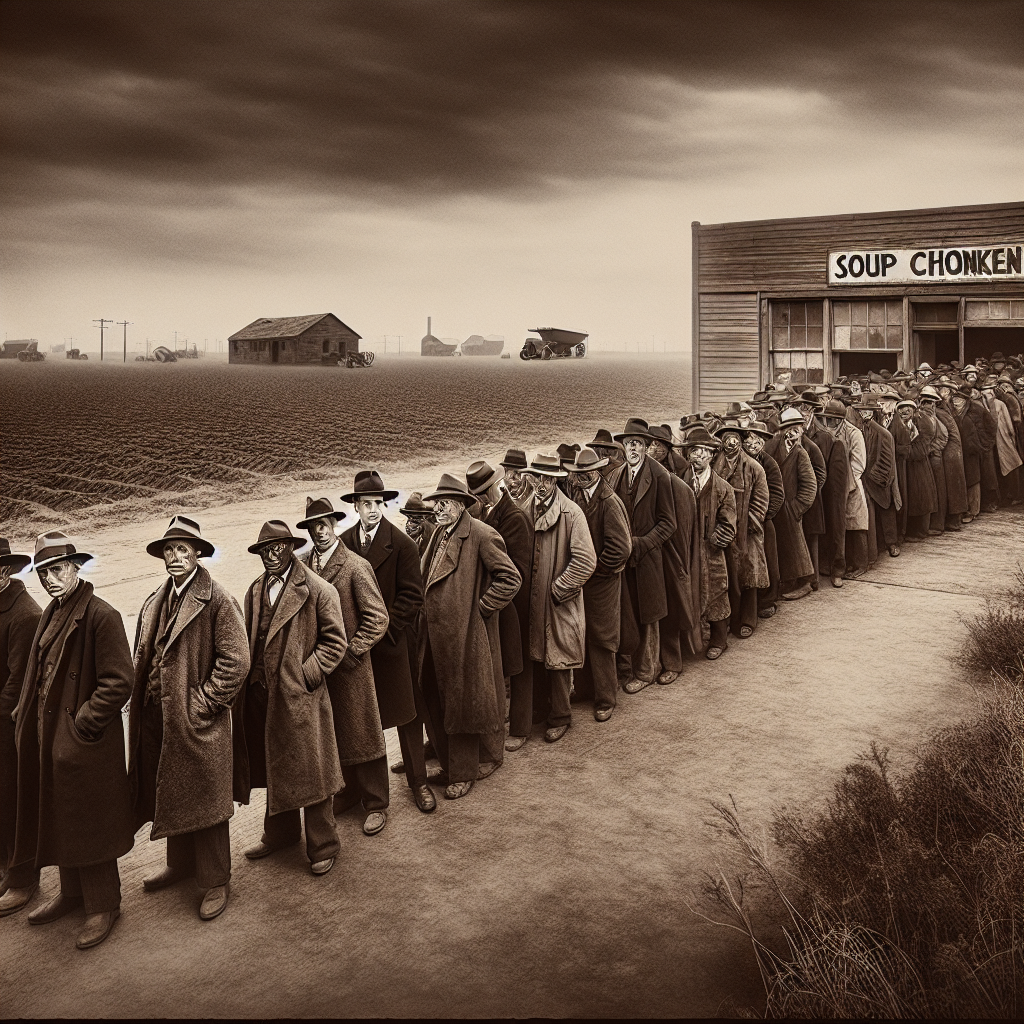
The stock market crash of October 1929 did not cause the Great Depression by itself — but it lit the fuse. Over the next three years, industrial production fell by half, roughly 9,000 banks failed, international trade collapsed, and unemployment climbed to 25 percent. In human terms that meant 13 million Americans out of work, millions of families evicted from farms and homes, and a psychological shock to the idea of American progress so profound that a generation never fully trusted prosperity again. The Depression was the worst economic disaster in American history, and its consequences extended to every corner of the country and every layer of society.
The federal government's initial response, under Herbert Hoover, was to wait. Hoover believed the economy would self-correct and that direct federal relief would destroy individual initiative — a conviction that allowed the catastrophe to deepen for three years before Franklin Roosevelt defeated him in a landslide in 1932. Roosevelt's New Deal did not end the Depression; the economy relapsed severely in 1937 when he cut federal spending too soon. What the New Deal did was transform the role of the federal government permanently: Social Security, the SEC, the FDIC, the NLRB, and the regulatory architecture of modern American capitalism all emerged from the emergency of those years.
The Depression's geography was not uniform. The Great Plains simultaneously endured an ecological catastrophe — the Dust Bowl — as decades of overplowing stripped the topsoil and drought turned it to airborne dust. Three million people fled the affected states, a migration that John Steinbeck documented in The Grapes of Wrath (1939). Black Americans, already at the bottom of the economic ladder, were the first fired and last hired throughout the Depression, their suffering compounded by the deliberate exclusion of domestic and agricultural workers — the jobs most Black Americans held — from most New Deal protections.
The Depression finally ended with World War II. Defense spending beginning in 1940 accomplished in two years what the New Deal had not managed in eight — full employment and economic growth. The war's mobilization also accelerated demographic and social changes the Depression had begun: women entered the industrial workforce at scale, Black Americans migrated north and west in the Second Great Migration, and the returning veterans of 1945, shaped by both the Depression and the war, came home to build the most prosperous era in American history. They also built Social Security into the untouchable political institution it became, having watched what happened to a generation without it.


| Period | 1929–1941 |
| Trigger | Stock market crash, October 24–29, 1929 ("Black Tuesday") |
| Peak unemployment | ~25% (1933) |
| Bank failures | ~9,000 (1929–1933) |
| GDP decline | ~30% from peak to trough |
| Dust Bowl states | Oklahoma, Texas, Kansas, Colorado, New Mexico |
| Federal response | Hoover (austerity) → Roosevelt (New Deal) |
| End | World War II defense mobilization, 1940–41 |
| Date | Black Tuesday: October 29, 1929 |
| Location | United States |