Franklin Pierce
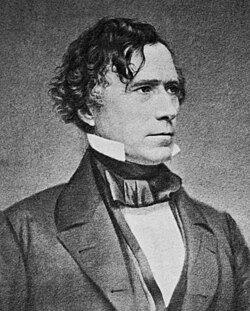
Franklin Pierce entered the White House in 1853 as a compromise candidate acceptable to the South — and spent four years demonstrating exactly why compromises rarely hold. Handsome, charming, and politically skilled, Pierce was deeply sympathetic to Southern interests at the moment when the question of slavery's expansion was becoming impossible to sidestep. His signature act, signing the Kansas-Nebraska Act of 1854, shredded the Missouri Compromise that had maintained an uneasy peace for 34 years and set the territories of Kansas ablaze with political violence.
"Bleeding Kansas" — the guerrilla war between pro-slavery and free-soil settlers that followed — exposed the fatal weakness of Pierce's approach. He recognized only the pro-slavery territorial government as legitimate, alienating Northern members of his own party and hastening the collapse of the Democrats as a national coalition. His one diplomatic achievement, the Gadsden Purchase of 1853, added the southern strip of present-day Arizona and New Mexico to the United States, clearing the route for a southern transcontinental railroad. It was too modest a gain against the damage done.
Pierce arrived at the presidency shadowed by grief — his young son Benjamin was killed in a train accident just weeks before the inauguration, and his wife Jane never recovered emotionally. He left office in 1857 as one of the most unpopular presidents in history, denied renomination by his own party. He spent his remaining years defending the South and opposing Lincoln's war effort, dying in relative obscurity in 1869.



| Born | November 23, 1804 — Hillsborough, New Hampshire |
| Died | October 8, 1869 — Concord, New Hampshire |
| Party | Democrat |
| Term | March 4, 1853 – March 4, 1857 |
| Vice President | William Rufus DeVane King (died in office, 1853) |
| Preceded by | Millard Fillmore |
| Succeeded by | James Buchanan |
| Key Act | Kansas-Nebraska Act, 1854 |
| Years | 1804–1869 |
| Location | Concord, New Hampshire |